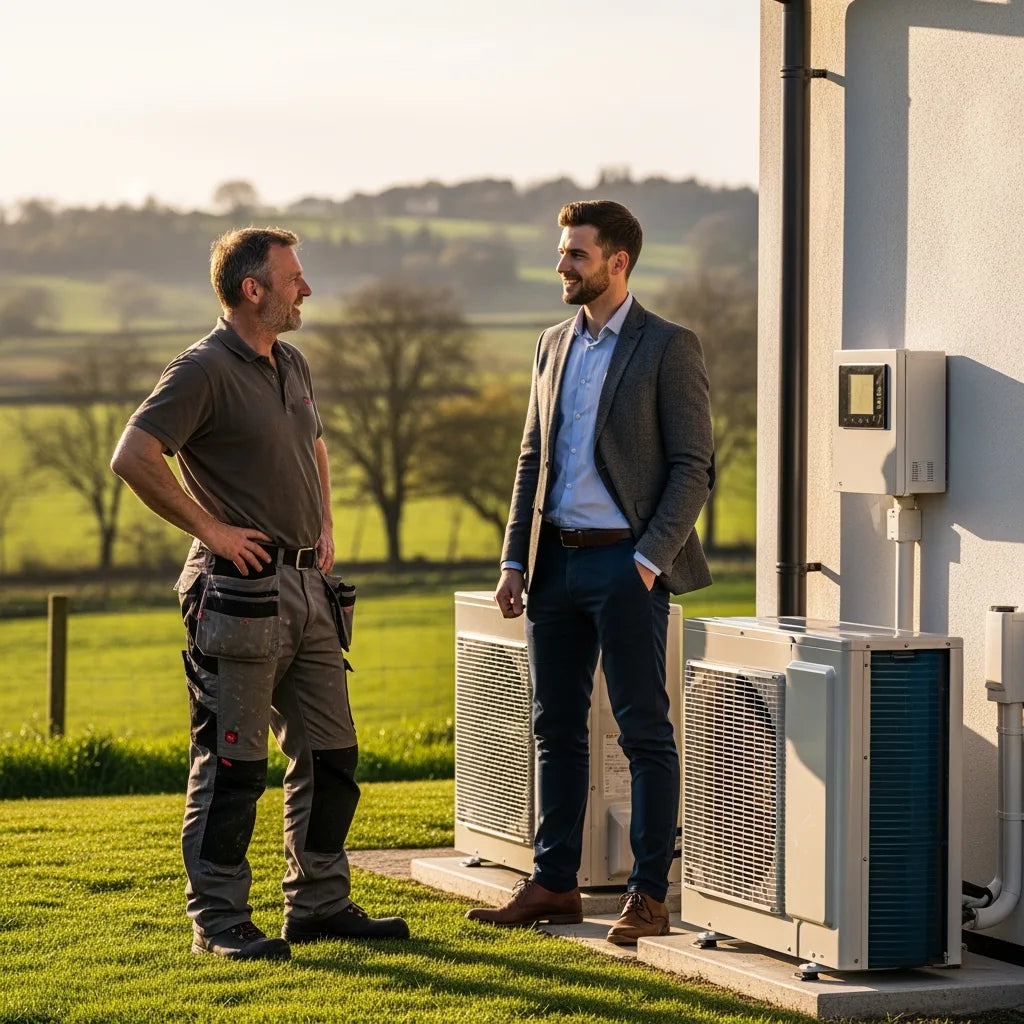

An anthracite heat pump cover can be compatible with correct operation when it is selected and installed for the particular outdoor unit. A dark surface may become hotter in sunshine, but surface temperature alone does not establish what happens to the air entering the coil. Airflow, recirculation, clearances and the installation layout need to be assessed together.
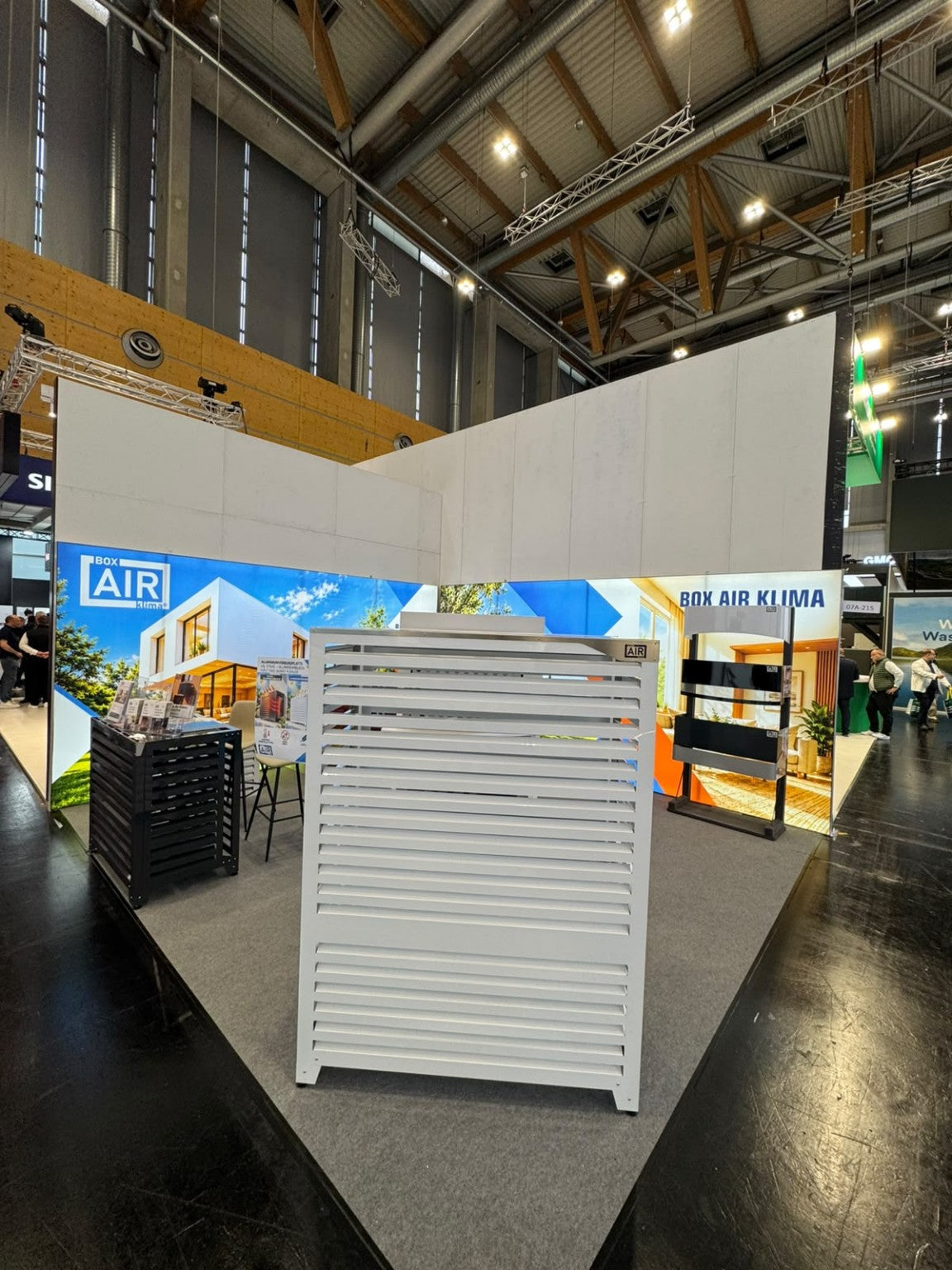
Box Air Klima offers Blade and Big Blade in anthracite as well as white. For installers, building services engineers and specifiers, this provides an architectural option that can coordinate with windows, railings and façade details. The technical assessment starts with the unit, rather than the colour alone.
Does an anthracite cover make a heat pump overheat?
Not necessarily. With conventional finishes under comparable exposure, a dark surface generally absorbs more solar energy than a white one. Wind, orientation and the coating’s optical properties also affect its temperature. That explains a hot outer panel; it does not demonstrate overheating or a specific loss of efficiency.
Separate three measurements: the outer panel temperature, the air temperature within the cover, and the entering-air temperature at the outdoor coil. Air within a ventilated cover is not at one uniform temperature. A thermal image of the panel cannot substitute for an air-temperature measurement.
What does the aluminium composite panel contribute?
Blade and Big Blade use aluminium composite panel, or ACP, for the external cladding: thin aluminium skins bonded to a polymer core. The layered construction provides stiffness with relatively low weight.
The core adds resistance to heat conduction through the panel compared with solid aluminium of the same overall thickness. This is one element of the design, not insulation for the whole heat pump. The cladding can intercept direct sunlight that would otherwise reach parts of the unit, while its warmed surfaces still exchange heat with the surroundings.
ACP does not make colour thermally irrelevant. The practical benefit is the ability to combine an anthracite finish with a ventilated enclosure design, subject to assessment for the selected unit and location.
Why entering air and recirculation matter
In heating mode, an air source heat pump extracts energy from outdoor air and discharges colder air. A reversible unit operating in cooling rejects heat and discharges warmer air. If discharge air returns to the inlet, the coil receives air that has already passed through the unit.
Check the whole route from intake to discharge, including nearby walls, recesses and other plant. The unit fitting inside a cover is not sufficient evidence of airflow compatibility. Required clearances and any restrictions on additional enclosures must come from the manufacturer’s documentation.
Specifying Blade or Big Blade
Blade in anthracite combines ACP panels with front and side openings. Big Blade is intended for larger outdoor units and uses a stainless steel supporting frame with ACP cladding. Wall-mounted, ground-mounted against a wall and freestanding configurations must each be checked against the site layout.
Big Blade’s manually adjustable louvres allow the opening geometry to be changed. Their setting must suit the airflow arrangement; closing them for greater visual screening while the unit is operating is not an acceptable substitute for a ventilation assessment.
A practical site-check sequence
- Record the exact unit model, refrigerant, intake and discharge locations, service clearances and enclosure restrictions.
- Include pipework, condensate drainage, defrost-water drainage and service access in the layout.
- Measure reference ambient air away from the discharge plume and entering air at suitable points with probes shielded from solar radiation.
- Record operating mode, load, sunlight and wind. Compare arrangements only under suitably comparable conditions; treat defrost periods separately.
- Review the temperatures alongside airflow observations and operating data. Temperature checks alone cannot quantify a change in COP or seasonal efficiency.
There is no universal acceptable temperature rise or cover-to-unit gap for every model. A project-specific review is needed where the manufacturer has not documented the combination. For R290 equipment, also check the specified protective zone and refrigerant-dispersion requirements before adding cladding.
UK projects: keep planning and sound assessment separate
For projects in England, check the applicable permitted-development conditions and MCS 020 a) requirements where relevant. The assessment concerns the installation, not simply the cover colour. Rules differ across the UK and other English-speaking markets. Do not assume that decorative cladding provides a tested acoustic reduction or that it automatically satisfies planning requirements.
Blade and Big Blade are discussed here as protective and architectural covers. No acoustic attenuation figure or independent heat pump efficiency test is claimed in this article.
Installer questions
Does an anthracite finish automatically reduce efficiency?
No. Colour alone establishes neither a performance penalty nor zero loss. Assess the entering air, possible recirculation and the complete installation against the unit manufacturer’s requirements.
Does ACP prevent all solar heat transfer?
No. The polymer core affects conduction through the panel, but heat exchange and ventilation still matter.
Is an infrared image enough to approve the installation?
No. It shows surface conditions and depends on measurement settings. Use appropriate air probes and the manufacturer’s requirements to assess the installation.
Prepare a specification with Box Air Klima
Send the unit model, dimensions, photographs, proposed location and service requirements through our contact page, or start with the cover configurator. This information helps assess the appropriate Blade or Big Blade configuration.
Technical references
US Department of Energy: surface reflectance and heat emission; 3A Composites: an example ACP technical data sheet (material-family reference, not identification of the panel supplied by Box Air Klima); Vaillant: example R290 protective-zone instructions; England: permitted-development legislation, Class G. Always use the documentation for the actual unit and the requirements applying to its location.
Technical content updated 29 October 2026.