

Heat pump · Outdoor unit · Correct installation
When people talk about the outdoor unit of a heat pump or the outdoor AC unit, they almost always focus on the brand, the model, or the declared performance. In the real world, though, a huge part of the result depends on a much more concrete factor: how the unit is installed in the space.
A modern unit can be efficient, quiet, and reliable, but it performs worse if it is suffocated, squeezed into a niche that is too tight, mounted too close to obstacles, or placed somewhere that is awkward to inspect and maintain. This is where space, ventilation, and technical common sense come into play.
What it really means to install an outdoor unit properly
A good outdoor unit installation does not simply mean finding a spot where “it fits.” It means choosing a position where the unit can draw in air, expel air, and remain accessible over time.
The most common mistakes are almost always the same: units pressed up against walls and railings, tight niches with no breathing room, spaces chosen only to hide the unit rather than help it work properly, or locations that look great on day one but become highly inconvenient for cleaning and maintenance.
So the real issue is not just where to place the unit. The real issue is how to keep it working properly for years, without turning the installation into a constant source of compromises.
In short: a sensible installation combines ventilation, space around the unit, and real access for maintenance, cleaning, and inspection.

Ventilation comes first
The main rule is simple: the outdoor unit must be able to take in and release air freely, in line with the manufacturer’s instructions. This applies to air-to-water heat pumps, air conditioner outdoor units, and, more generally, to all systems that work by exchanging air with the outside environment.
When this principle is ignored, problems begin. A niche that is too tight, a barrier that is too close, a makeshift screen, or an enclosure that encourages recirculation of discharged air can worsen the real-world behavior of the system.
This is why, when thinking about protection or a cover, the first question should not be “how do I hide it?” but rather “how do I avoid restricting its breathing?”.
To explore the topic further from an installation and energy-context perspective, you can also see the Fraunhofer ISE page on heat pump installation and operation and the European Commission section dedicated to heat pumps.
How much space should you leave around the outdoor unit?
This is one of the most common searches online: how much space should you leave around an outdoor unit? The correct answer is that there is no universal measurement that works for every unit. Brands, models, geometries, fan position, unit depth, and installation instructions all vary.
What really matters is the principle: you need to avoid conditions where incoming or outgoing airflow is disrupted, and you need to leave enough space to make inspection, cleaning, and technical access practical as well.
In other words, it is not enough for the unit to physically fit into the space. It must also be able to work properly there.
Practical rule: the exact clearances should always be checked in the manufacturer’s manual. This article is meant to clarify technical common sense, not replace the instructions for your specific model.

Space for maintenance and inspection
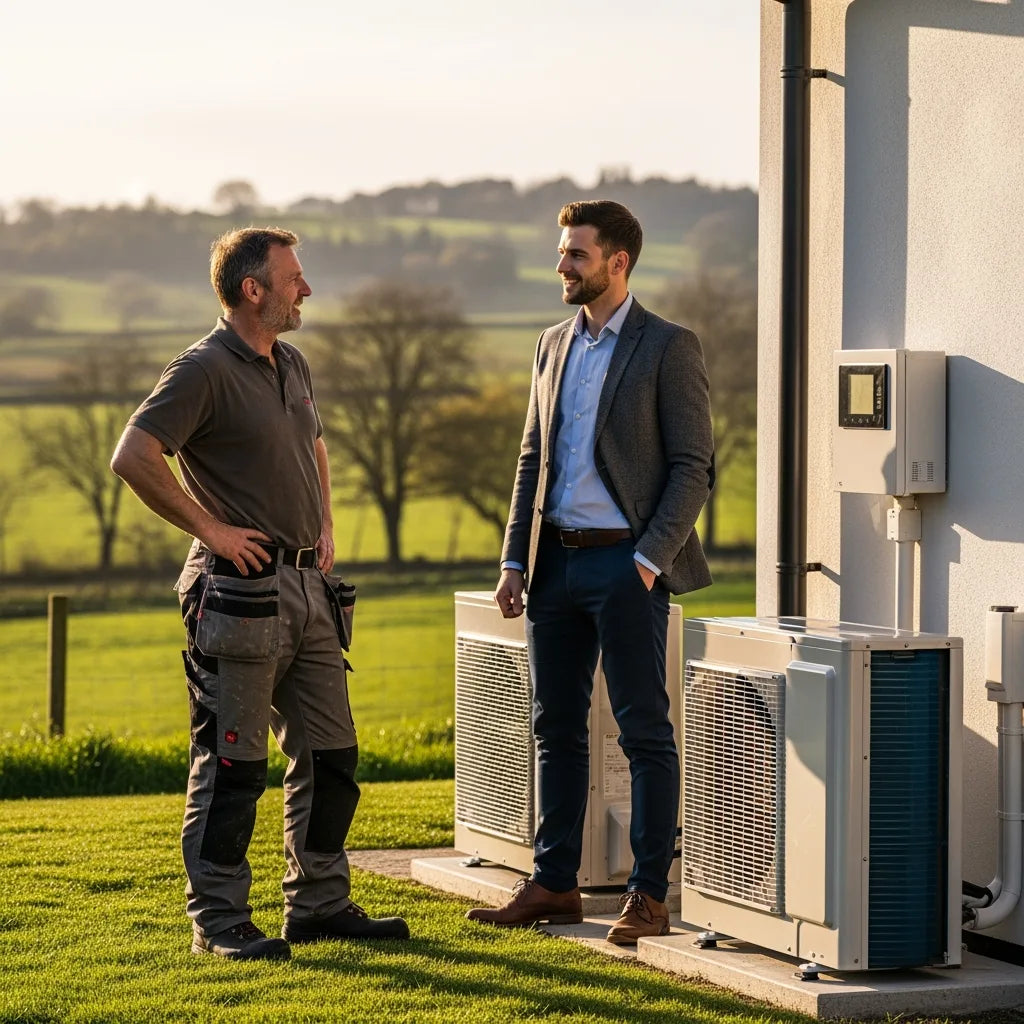
A good installation does not only think about day one. It also thinks about the years that follow. A well-installed outdoor unit must be easy to clean, inspect, and reach without unnecessary complications.
This point is often underestimated. People choose the most discreet spot or the cleanest-looking one, and then end up with a unit that is difficult to inspect, inconvenient to maintain, and impractical for every future intervention.
When access is awkward, maintenance becomes more difficult. And when something is difficult, it often gets postponed. That is also why accessibility is part of installation quality.
Balconies, façades, courtyards, and gardens: context matters
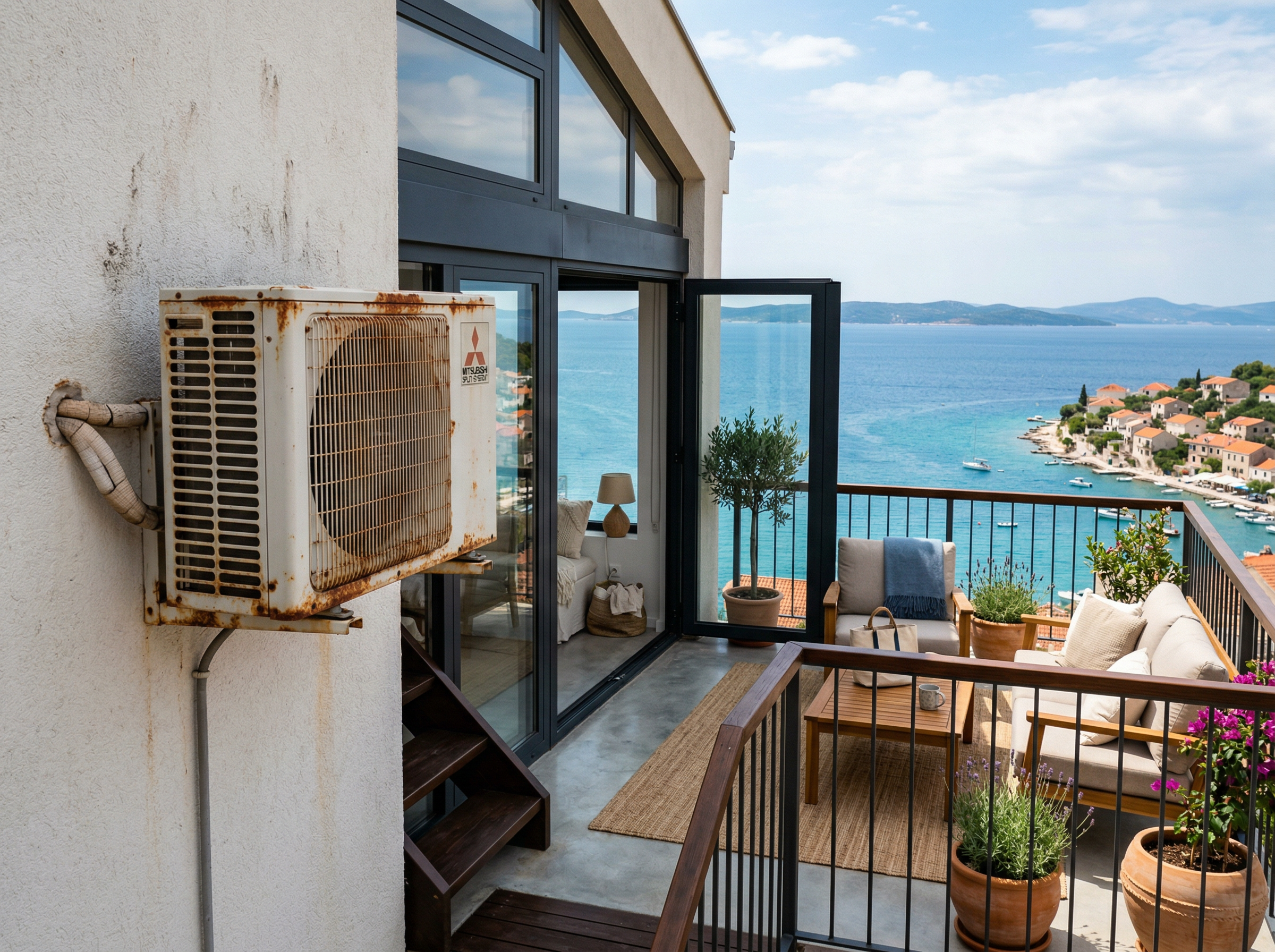
In Europe, there is no single installation scenario. In many Mediterranean areas, façades, balconies, terraces, and internal courtyards are common. In other regions, gardens, dedicated pads, and outdoor bases are more typical. This greatly changes the way the outdoor unit is perceived, protected, and integrated into the space.
A unit installed on a narrow balcony does not create the same challenges as one installed in a garden. A heat pump exposed on a façade does not have the same visual impact as a unit placed in a side technical area. That is why the installation design must always adapt to the real building context.
If you want to frame this building-system level more clearly, the European Commission page on the EPBD can also be useful, since it deals precisely with a highly heterogeneous building stock.
So, does a cover suffocate the outdoor unit?
After clarifying that a correct outdoor unit installation requires space, ventilation, and accessibility, the question comes naturally: doesn’t a cover risk making everything worse?
The honest answer is: it depends on how it is designed. A makeshift cover that is too enclosed, too close to the unit, or designed only to hide it can actually restrict airflow.
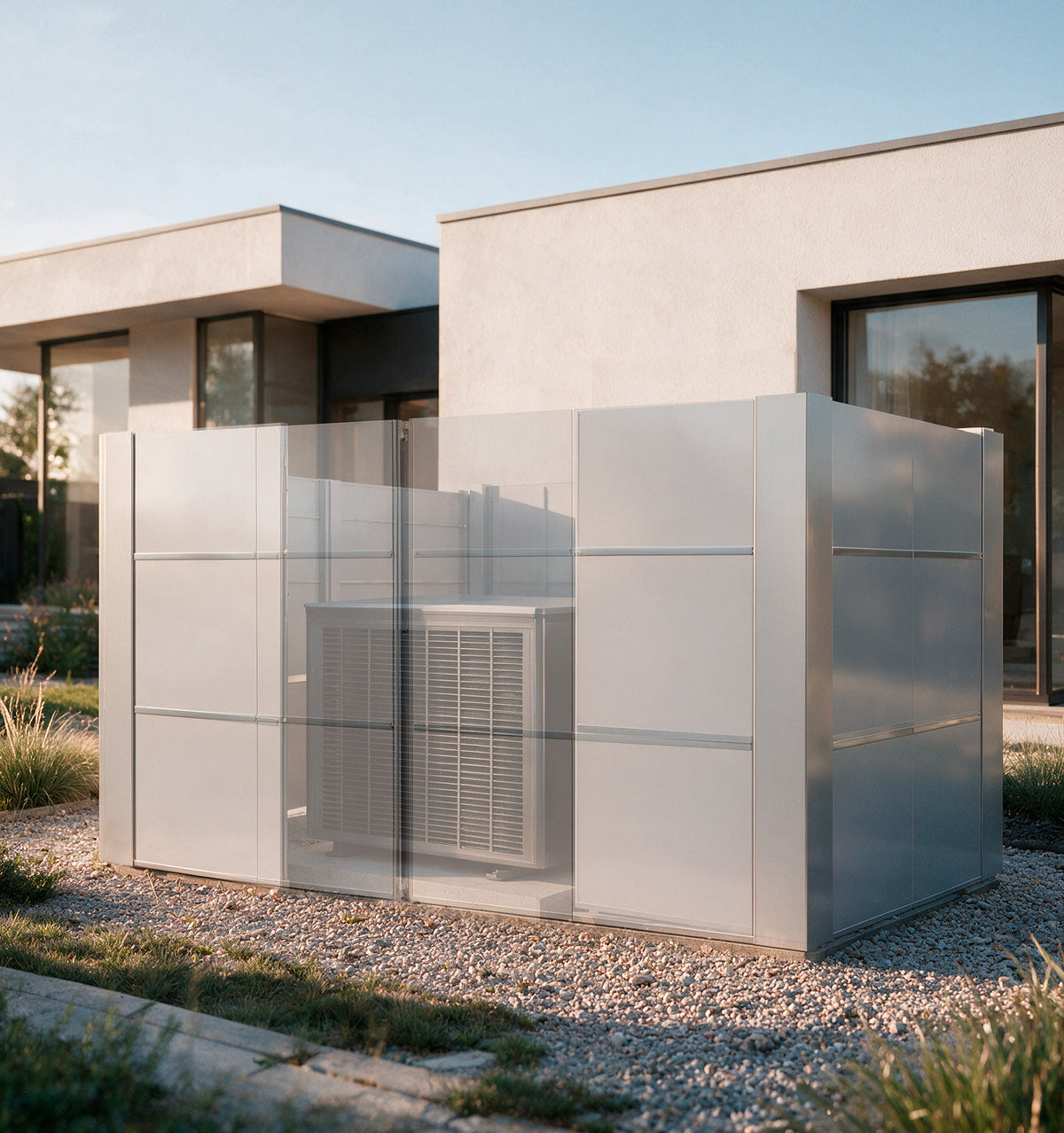
A well-designed technical cover, on the other hand, is not created to turn the outdoor unit into a box. It is designed to coexist with the way the unit works: to protect it, organize it, and integrate it better, while still leaving it the space and airflow it needs.
So yes: a cover can suffocate the unit if it is poorly designed. No, it does not suffocate it if it is designed starting from the correct principles of ventilation, heat discharge, and accessibility.

Box Air Klima covers are designed to avoid hot air stagnation
The point is not to cover the outdoor unit at all costs. The point is to protect it without disrupting its ventilation balance. That is why Box Air Klima solutions are designed as technical screens, not as blind, closed volumes.
The design logic starts exactly here: let air enter where it needs to and encourage hot air to escape naturally, without creating buildup, recirculation, or unnecessary obstacles around the unit.
Top ventilation
When the unit is operating, heat must be able to dissipate. A well-designed cover avoids a sealed-off effect at the top and helps encourage the natural rise of hot air.

Side ventilation
A poorly designed cover can disrupt incoming airflow. A well-designed cover works with the unit by allowing smoother air intake, without creating unnecessary obstacles on the sides.

Raised structure
The bottom matters too. A raised structure helps leave more breathing room in the lower area and improves airflow from below, avoiding an overly closed effect near the ground.

Front and side louvers
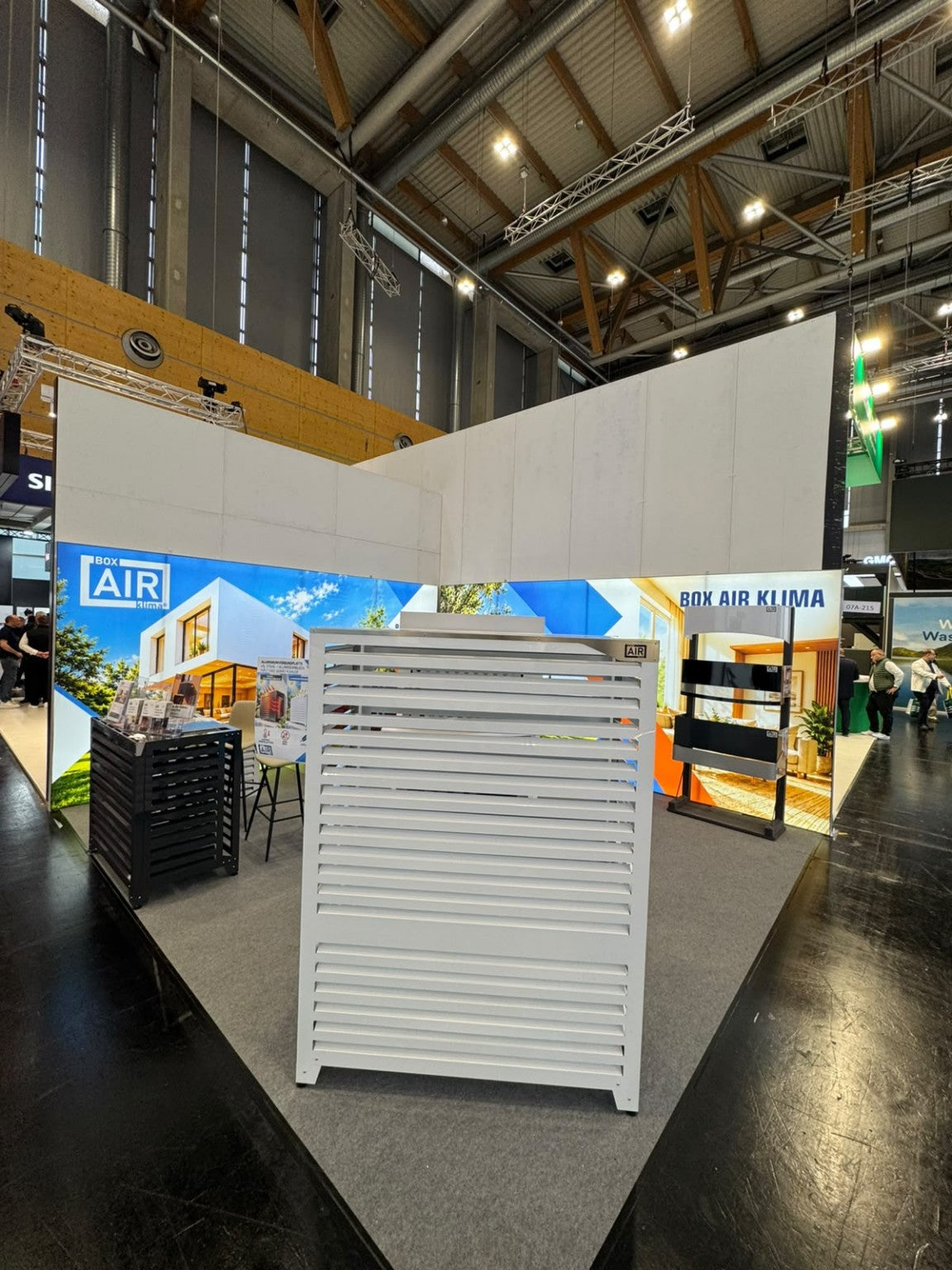
Louvers are not only there for visual screening. They also help create a protection system that does not become a blind barrier, allowing the unit a more coherent heat outlet.

This is exactly where Box Air Klima fits in: not as a solution to fix a bad installation, but as a coherent extension of a good installation. If the outdoor unit is positioned correctly, a thoughtfully designed screen can add visual order, protection from the elements, and aesthetic integration, without betraying the unit’s ventilation needs.
In other words: Box Air Klima is not designed to close off the outdoor unit. It is designed to protect it and integrate it better, starting from the assumption that the unit must continue to breathe properly.
Standard sizes and large sizes: how to choose
For many compact residential outdoor units, the starting point is the standard sizes. If the unit is larger, taller, or vertical in configuration, it is better to move directly to the dedicated collection of heat pump covers.
Standard size
S
Internal — 82 × 67 × 45–51 cm
External — 90 × 70 × 49–55 cm
Standard size
M
Internal — 92 × 82 × 50–56 cm
External — 100 × 85 × 54–60 cm
Standard size
L
Internal — 97 × 92 × 55–61 cm
External — 105 × 95 × 59–65 cm
If the unit exceeds size L, or has a taller, vertical, or large-format configuration, the correct starting point is the heat pump covers collection.
Available large sizes include XL, XXL, 3XL, 5XL and the vertical variants VL and VXL:
XL — internal 107 × 92 × 57–63 cm
XXL — internal 127 × 109 × 64–70 cm
3XL — internal 142 × 109 × 74–80 cm
5XL — internal 180 × 146 × 115–121 cm
VL — internal 97 × 147 × 55–61 cm
VXL — internal 125 × 169 × 64–70 cm
Note: if you have a very compact unit, before moving to large sizes it is worth checking the outdoor air conditioner covers collection as well.
Useful collections by brand and model
Looking for a cover for a specific air conditioner or heat pump?
Many searches start directly from the machine name: Daikin Perfera cover, Mitsubishi MSZ-AP cover, Samsung WindFree outdoor unit cover, Panasonic Aquarea cover, Vaillant aroTHERM cover. It is a great starting point, but the right choice always depends on actual dimensions, depth, unit configuration, and available space around the unit as well.
Note: this section is meant to guide the reader toward the most sensible collection to start from. Final compatibility must always be checked against the unit’s actual dimensions, depth, side clearance, and the real installation setup.
Frequently asked questions
FAQ on correct outdoor unit installation
Quick answers to the most common questions about space around the outdoor unit, ventilation, tight niches, installation on a balcony or façade, and the key question of this article: does a cover really suffocate the unit?
How much space should be left around the outdoor unit?
There is no single measurement that applies to all models. The correct criterion is to leave enough space for airflow, avoid obstacles that are too close, and always follow the manufacturer’s manual.
What is the minimum wall clearance for a heat pump or outdoor air conditioner?
The minimum wall clearance is not the same for every unit. It depends on the model and the unit geometry. That is why it should always be checked in the manufacturer’s installation manual.
Can I completely enclose the outdoor unit to hide it?
No. An outdoor unit needs to breathe. A complete or makeshift enclosure can obstruct airflow and make the installation worse.
Can a heat pump be installed in a tight niche?
Only if the niche truly allows coherent ventilation, maintenance access, and compliance with the clearances required by the manufacturer. In many cases, a niche that is too tight is more problematic than smart.
Can an outdoor unit be installed properly on a small balcony?
It depends on the actual space, position, nearby obstacles, and the model manual. A small balcony is not automatically a problem, but it requires much more attention to ventilation and accessibility.
Can a heat pump or air conditioner cover block the outgoing heat?
That can happen with a cover that is too enclosed or poorly designed. A well-designed technical cover, on the other hand, should promote hot air discharge, side airflow, and overall breathing room around the unit.
Can a cover block heat pump ventilation?
A poorly designed cover can, yes. A technical cover designed with the right openings, spacing, and geometry is instead created to protect without suffocating the unit.
Is it really necessary to leave space for maintenance and cleaning?
Yes. A good installation must also think about the years ahead. If the unit is too difficult to reach, every check or cleaning task becomes more complicated.
Is it better to install the outdoor unit on the ground or on the wall?
There is no universal answer. What matters most is that the chosen solution guarantees stability, space for airflow, accessibility, and consistency with the building context.
Should a Box Air Klima cover already be considered during the installation phase?
Ideally, yes. Thinking about it already during the installation phase helps plan overall dimensions, technical access, tidiness around the unit, and aesthetic integration more effectively.
How do I know whether size S, M, or L is enough for me?
You need to compare the actual dimensions of your outdoor unit with the internal dimensions of the cover. S, M, and L cover a large share of compact models; if the unit is larger or taller, it is better to move to the heat pump collection.
When should I move to heat pump covers?
When the unit exceeds size L, when it has significant depth, when you move into sizes such as XL, XXL, 3XL, 5XL, or into VL and VXL configurations.
I’m looking for a cover for Daikin Perfera, Mitsubishi MSZ-AP, Samsung WindFree, or Panasonic Aquarea: where should I start?
Start from the model name, then always check the dimensions, depth, and configuration of the outdoor unit. For compact air conditioners, the starting point is often the outdoor air conditioner covers collection; for larger units, you move to the heat pump covers collection.
Can a cover also help visually on a façade or in a condominium setting?
Yes, when the initial installation is correct. A well-designed screen can improve visual order and integration with a façade, terrace, or courtyard, without turning the unit into a blind box.