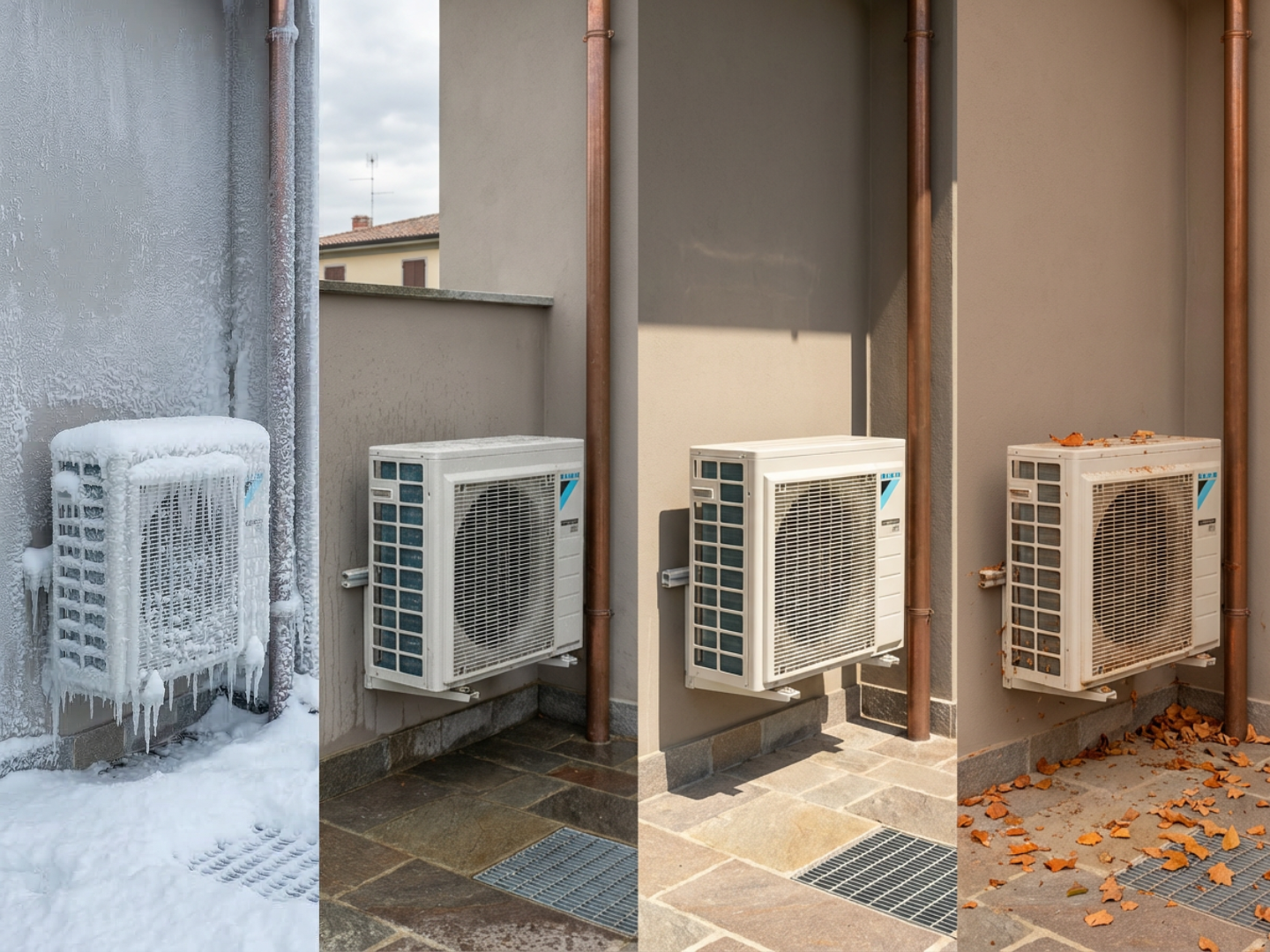


When talking about the outdoor unit of an air conditioner, people almost always think about energy consumption, performance, and comfort. Much less often do they consider a factor that quietly works every day, for months and years: constant exposure to sunlight and UV rays.
The outdoor AC unit is in fact left outside, often in direct sunlight, on façades, balconies, terraces, or in gardens. And this is exactly where a series of concrete effects begin: surfaces that get extremely hot in summer, materials that age faster, finishes that lose their visual quality, and an aesthetic impact that gets worse over time.
This applies to many residential systems: Daikin Perfera, Daikin Comfora, Daikin Sensira, Mitsubishi Electric MSZ-AP, Mitsubishi Kirigamine, Samsung WindFree, Panasonic TZ, Panasonic Etherea, LG DUALCOOL, Haier Flexis, and many others.
In this article, we look at why it makes sense to protect the outdoor air conditioner unit from the sun, what UV rays have to do with the aging of the system, and how to choose between S, M, and L sizes, as well as larger solutions when you go beyond standard dimensions.
1. Direct sunlight and summer heat: why they really matter
An outdoor air conditioner unit is designed to stay outside, but that does not mean direct sunlight is irrelevant. When the unit is exposed for hours a day, especially on bright walls or balconies facing south or west, the entire outer structure is subjected to a constant thermal load.
In practical terms, direct sunlight brings three simple effects:
- the outer surfaces heat up more;
- the unit remains in a hotter, more stressful environment;
- materials and finishes are put under pressure every day throughout the hot season.

This is not about “closing off” the air conditioner or sealing it completely. It is more about reducing direct solar exposure on the most exposed parts and preventing the unit from remaining continuously under the sun during the hottest hours.
A well-designed cover can help precisely with this: shielding the sun without compromising the unit’s operation.
2. UV rays and material aging
UV rays are one of the most underestimated factors when talking about an outdoor unit. You cannot see them, but over time they act on plastics, finishes, coatings, seals, and exposed components.
The result is not always immediate. More often, it is a slow, progressive deterioration that, year after year, makes the unit look more worn, less uniform, and visually more “tired.”
Typical signs may include:
- fading or yellowing of some parts;
- more matte and less uniform surfaces;
- plastics that over time look drier or more fragile;
- finishes that lose visual quality earlier than expected.

This is why protecting the outdoor unit from the sun is not just an aesthetic choice: it also means helping materials age better, by reducing direct exposure to the most aggressive conditions.
3. Composite aluminum and heat transfer: why the material makes a difference
When evaluating an outdoor air conditioner cover, the material is not a secondary detail. It matters in terms of aesthetics, structure, and also thermal behavior. A cover exposed to the sun heats up as well, and that is exactly where the material choice becomes important.
Talking about composite aluminum makes sense precisely from this point of view. Not because the cover should become an airtight box, but because it is useful to have a structure capable of managing surface heat more effectively, with more balanced behavior under the sun compared to makeshift, lightweight, or unstable solutions.

This is also where the issue of heat transfer comes into play: when the sun directly hits the cover, what matters is how the material absorbs, distributes, and transfers heat. A well-designed solution helps prevent the sun from turning the cover itself into an element that becomes critically overheated.
In other words, it is not enough for a cover to simply “cover.” It also needs to be made from a material suitable for outdoor use, stable over time, and consistent with real-world installation on balconies, façades, and highly exposed terraces.
4. Aesthetics change too, and often for the worse
When an outdoor air conditioning unit remains completely exposed, the visual effect gets worse over time more than most people think. It is not just about “seeing the unit”: it is about how that unit ages visually, season after season.
Sun, UV rays, dust, rain, and dirt can all leave a visible mark. The result, especially in well-kept environments, is a unit that looks older, more worn, and more invasive than it did at the beginning.

Over time, you may end up with:
- yellowed or faded parts;
- more matte plastics;
- small surface marks or microcracks on the most stressed areas;
- a general perception of a less well-kept outdoor space.
This matters especially on balconies, terraces, carefully designed façades, outdoor seating areas, holiday homes, and any setting where the outdoor area is an important part of the home’s quality. In these cases, protection and aesthetic integration go hand in hand.
5. Protection is good, but not if it blocks ventilation
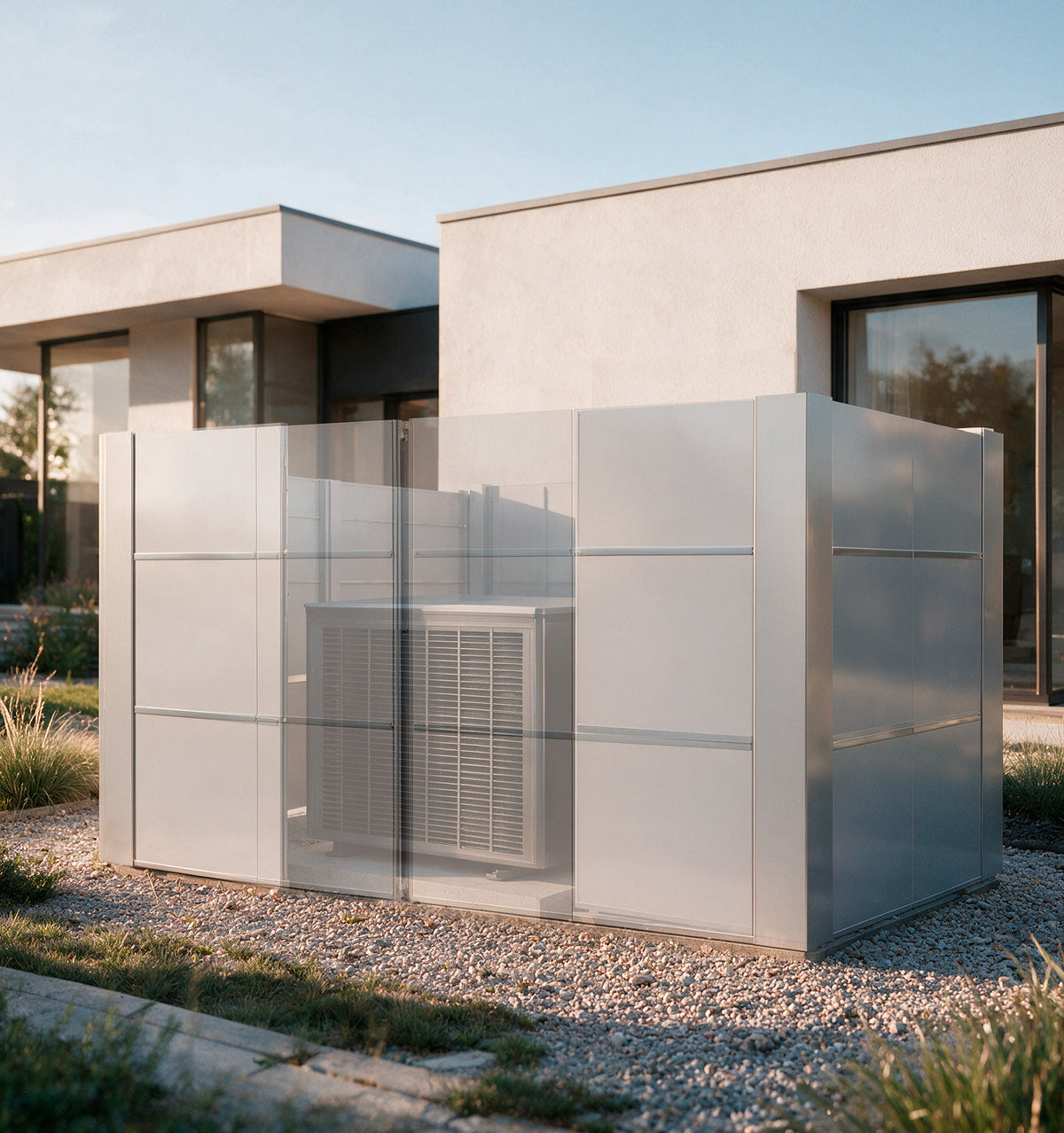
This remains the decisive point. A cover for an outdoor unit only makes sense if it is designed to protect without suffocating. A solution that is too closed, improvised, or poorly designed can interfere with proper airflow.
A sensible solution does the opposite: it helps shield the unit from sun and weather while still leaving the space it needs to breathe, operate properly, and remain accessible for cleaning and maintenance.

This is why, when evaluating a cover, what really matters is:
- the geometry of the structure;
- the clearance around the unit;
- the openness of the design;
- easy access to the unit.
A good cover should not just look nice. It has to coexist properly with the real operating needs of the air conditioner.
6. S, M, L sizes: how to choose
For most compact monosplit and multisplit outdoor air conditioners, choosing the right cover starts with the actual dimensions of the unit. Our three standard sizes make it possible to fit the vast majority of models on the market.

Size S
S
Internal — 82 × 67 × 45–51 cm
External — 90 × 70 × 49–55 cm
Size M
M
Internal — 92 × 82 × 50–56 cm
External — 100 × 85 × 54–60 cm
Size L
L
Internal — 97 × 92 × 55–61 cm
External — 105 × 95 × 59–65 cm
If, on the other hand, the outdoor unit is larger than size L, has substantial overall dimensions, or features a dual vertical fan configuration, then it makes more sense to move directly to the heat pump cover collection, specifically designed for larger units.
Note: the Cover Clima Hi-Fi model does not follow the standard size measurements. In that case, it is better to refer directly to the product page.
7. This also applies to the most common air conditioner brands
Anyone who owns a Daikin Perfera, Daikin Comfora, Daikin Sensira, Mitsubishi Electric MSZ-AP, Mitsubishi Kirigamine, Samsung WindFree, Panasonic TZ, Panasonic Etherea, LG DUALCOOL, or Haier Flexis faces the same practical issue: the outdoor unit is still exposed, and the sun hits all of them in the same way.
The real difference is not made by the brand name, but by the actual dimensions of the unit, its degree of exposure to the sun, and the quality of the solution chosen to protect it.
That is why, when evaluating a cover, it makes sense to think first of all about three things:
- how exposed the unit is during the hottest hours;
- how visually intrusive it is in the space;
- whether the size truly fits within the standard dimensions.
When it really makes sense to install a cover for an outdoor air conditioner
If your unit is exposed to the sun for many hours, if it is in a highly visible position, if you want to reduce the impact of UV rays and weather on the outer surfaces, or if you want a tidier and more coherent outdoor area, then yes: it makes sense to consider an outdoor air conditioner cover.
The key point is choosing a solution specifically designed for this purpose, not just any compromise.
In this dedicated section for outdoor air conditioner covers, you can view models designed for most compact residential units. If, however, you have a very large, deep unit or one with a vertical configuration, it is better to start directly from the heat pump cover collection.
Useful collections by brand and model
Looking for a cover for a specific air conditioner?
Here you will find quick guidance on the models most searched for online. For many residential air conditioners, the starting point is the outdoor air conditioner cover collection; if the unit is oversized, very deep, or has dual vertical fans, the correct choice is the heat pump cover collection.
Note: this section is intended to quickly guide the reader toward the most sensible collection to start from. Final compatibility should always be checked on the product page and, if needed, with the actual measurements in hand.
Frequently asked questions
FAQ on protecting the outdoor air conditioner unit
Quick answers to the most common questions about sun, UV rays, ventilation, sizes, and choosing the most suitable solution.
Can the sun damage the outdoor air conditioner unit?
Over time, direct sunlight can increase the surface thermal load and accelerate the aesthetic deterioration of materials, finishes, and exposed parts. That is why better shielding the unit can make sense, especially in very sunny positions.
Do UV rays affect the aging of an outdoor air conditioner?
Yes, especially on the outer parts and exposed materials. Over time, UV rays can contribute to fading, loss of uniformity, and visual aging of surfaces.
Why does the cover material matter against direct sunlight?
Because a cover exposed to the sun heats up as well. A material designed for outdoor use, such as composite aluminum, helps manage solar exposure, stability, and long-term behavior more effectively than improvised or unsuitable solutions.
Can you cover an outdoor air conditioner without suffocating it?
Yes, but it requires a cover designed with the right openings, distances, and geometry. An improvised solution may be too closed; a well-designed one protects the unit while allowing it to breathe.
How do I know whether I need size S, M, or L?
You need to compare the actual measurements of your outdoor unit with the internal dimensions of the cover. S, M, and L fit the vast majority of compact residential air conditioners. If the unit is oversized, very large, or has dual vertical fans, it is better to move to the heat pump collection.
When should I switch to heat pump covers?
When the unit exceeds size L, when it has significant depth, when dealing with very large systems, or when facing dual vertical fan configurations. In that case, the heat pump collection is the most sensible route.